
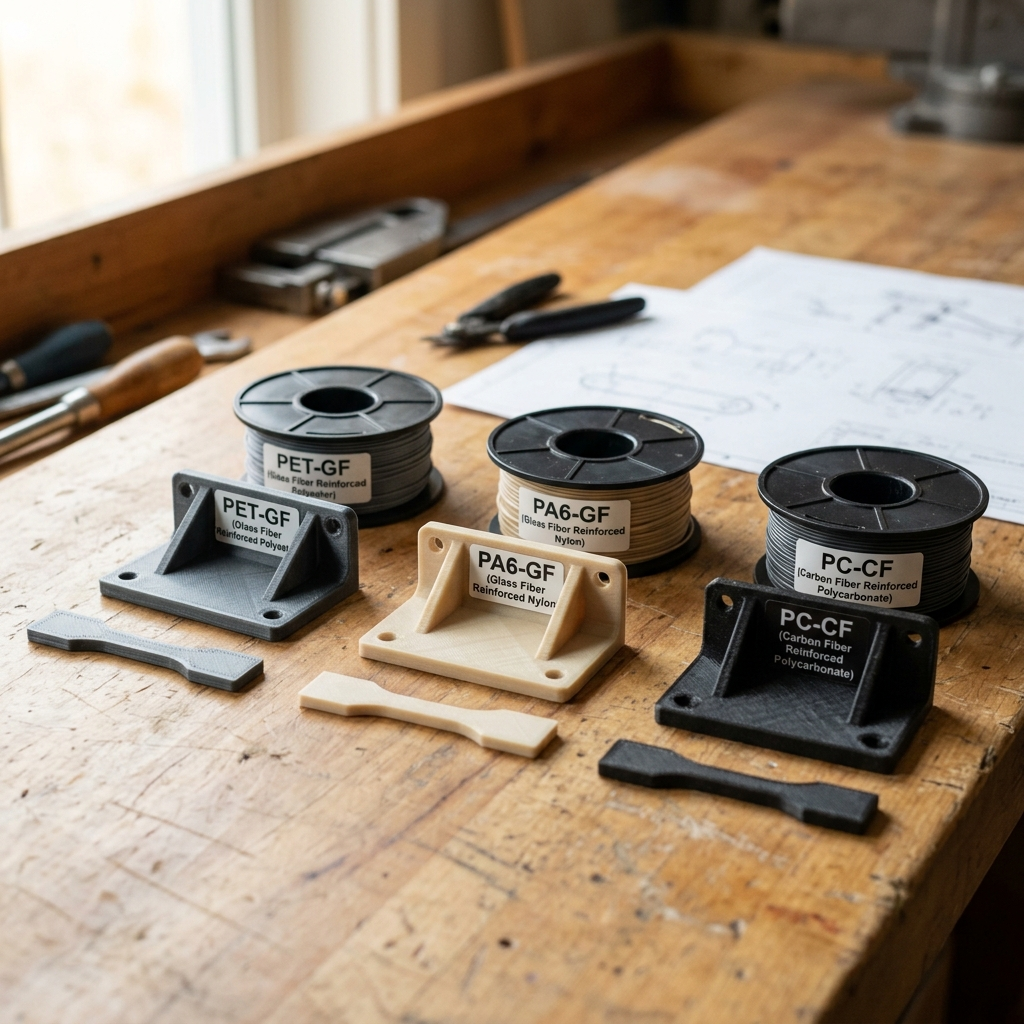
1. PET-GF: The Balanced All-Rounder
- High Stiffness and Dimensional Stability: The addition of glass fiber significantly reduces the coefficient of thermal expansion (CTE), ensuring the part maintains its shape under temperature fluctuations.
- Chemical Resistance: PET-GF exhibits excellent resistance to oils, greases, and many solvents, making it ideal for automotive under-the-hood components and industrial machinery parts.
- Processability: It has a relatively low melting point compared to other engineering plastics, allowing for easier printing or molding with reduced warping risks.
- Automotive: Intake manifolds, sensor housings, and electrical connectors.
- Consumer Electronics: Durable casings and structural brackets.
- Industrial Automation: Gear housings and conveyor system components.
2. PA6-GF: The High-Performance Heavyweight
Nylon 6 (Polyamide 6) reinforced with glass fiber is renowned for its exceptional mechanical strength, fatigue resistance, and toughness. While it offers superior performance in terms of load-bearing capacity, it comes with the well-known challenge of high moisture absorption, which can alter its dimensional stability and mechanical properties if not properly dried before processing.
Key Characteristics
- Superior Mechanical Strength: PA6-GF has high tensile strength and impact resistance, often outperforming PET-GF in dynamic loading scenarios.
- Wear and Abrasion Resistance: The self-lubricating nature of nylon makes it excellent for moving parts, such as gears, bearings, and bushings.
- Moisture Sensitivity: Engineers must account for "wet" vs. "dry" conditions. In a humid environment, PA6-GF can swell and lose some stiffness, though it gains toughness.
- Automotive: Engine mounts, fuel lines, and suspension components.
- Tooling: Jigs, fixtures, and custom tool holders due to its durability.
- Robotics: Joint components and robotic arms requiring high fatigue life.
Polycarbonate (PC) reinforced with carbon fiber represents the pinnacle of specific strength (strength-to-weight ratio). While Polycarbonate is known for its extreme toughness and transparency (in unreinforced forms), adding carbon fiber enhances its stiffness and thermal stability while maintaining a sleek, matte black finish. This material is ideal when weight reduction is paramount without sacrificing structural integrity.
Key Characteristics
- Extreme Strength-to-Weight Ratio: Carbon fiber reinforcement provides higher stiffness than glass fiber at lower densities.
- High Heat Deflection Temperature (HDT): PC-CF maintains its properties at higher temperatures than standard PC, though generally slightly lower than highly filled Nylons in extreme heat.
- Aesthetic Finish: The carbon fiber weave offers a premium, professional appearance often preferred for visible consumer-facing components.
- UV Stability: Unlike some Nylons, Polycarbonate-based composites generally offer better UV resistance, reducing yellowing over time.
- Aerospace: Drone frames, interior brackets, and lightweight structural supports.
- High-End Consumer Goods: Camera bodies, drone frames, and premium laptop chassis.
- Medical Devices: Surgical instrument housings where sterilization and lightweight are critical.
Choosing the right material requires answering three key questions: What is the load? What is the environment? and What is the budget?
Choose PET-GF When:
1. You need a cost-effective solution that still offers significant improvement over ABS or PLA.
2. Dimensional stability is critical, and you cannot control humidity in your storage environment.
3. The part will be exposed to oils, fuels, or mild solvents.
4. You require a good balance of stiffness and moderate impact resistance.
Choose PA6-GF When:
1. High mechanical strength and toughness are the primary requirements.
2. The part is subject to dynamic loads, vibration, or impact (e.g., gears, clips).
3. The application involves friction or wear (self-lubricating properties are beneficial).
Choose PC-CF When:
1. Weight reduction is the top priority (e.g., aerospace, drones, handheld devices).
2. You need maximum stiffness relative to the weight of the part.
3. The part is visible and requires a premium, aesthetic finish.
4. The application requires high impact resistance combined with a sleek profile, such as protective eyewear or camera bodies.
Why Partner with Precis3D?
Understanding the theory is only half the battle. At Precis3D.hr, we specialize in translating these material properties into tangible results. Whether you are prototyping a complex gear assembly using PA6-GF or designing a lightweight drone frame with PC-CF, our expertise ensures that your material selection aligns perfectly with your needs.
We offer:
- Material Consultation: Expert advice on selecting the optimal polymer for your specific stress, thermal, and chemical requirements.
- Precision Manufacturing: State-of-the-art FDM and SLA technologies capable of handling high-performance composites.
- Post-Processing Services: From annealing PA6-GF to enhance crystallinity to surface finishing for PC-CF aesthetics.
The choice between PET-GF, PA6-GF, and PC-CF is not about finding the "best" material in a vacuum, but rather finding the right material for your specific engineering constraints. PET-GF offers balance and ease of use, PA6-GF delivers raw strength and durability, and PC-CF provides unparalleled strength-to-weight ratios.
Contact us and we will find a solution for you.
Get a quote
Plain-English guides on choosing the right 3D printing technology, material selection and design for additive manufacturing.