
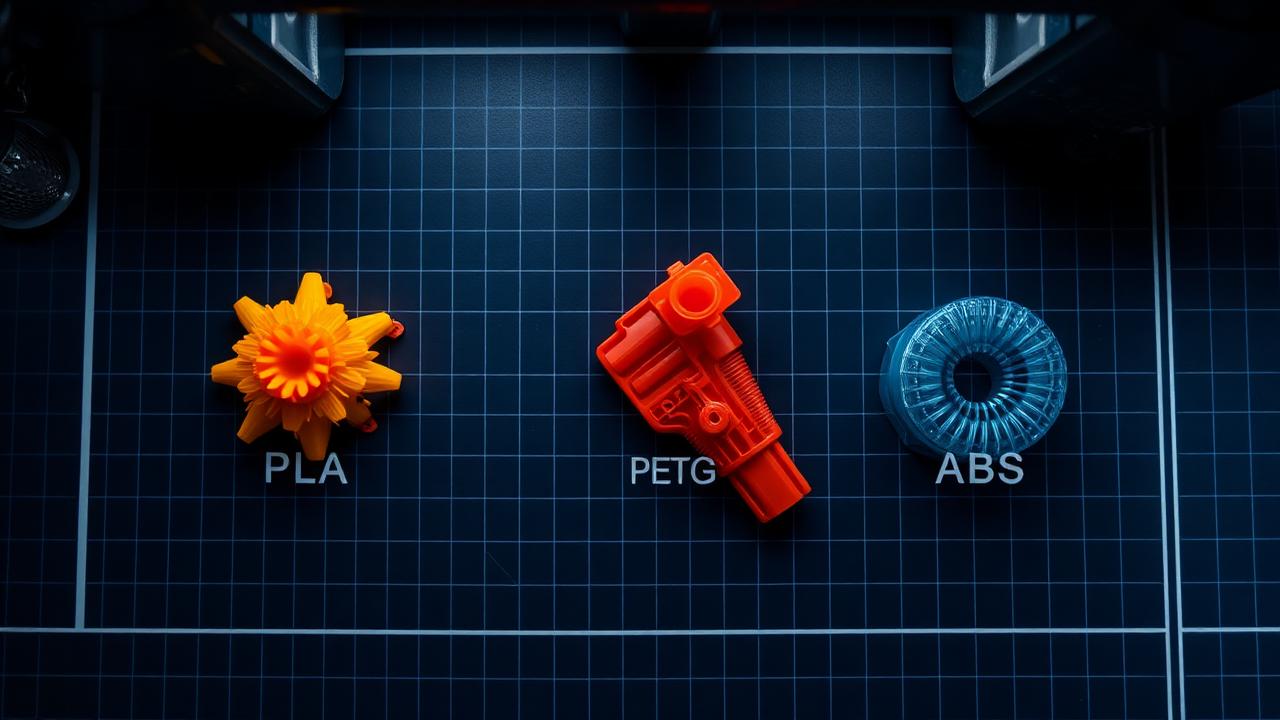
The 30-second answer
PLA is the easiest to print and the cheapest, but it softens at ~55 °C and embrittles outdoors. PETG is the best all-round engineering filament — tough, weatherproof, chemical-resistant and almost as easy as PLA. ABS is the classic for high-temperature, machinable parts but needs an enclosed printer and emits styrene fumes.
PLA — for visual prototypes and simple parts
Polylactic acid is plant-based, prints at 200 °C with zero warping and produces sharp detail. Use it for concept models, display pieces, low-stress fixtures and anything that lives indoors at room temperature. Avoid it for: anything in a parked car, anything outdoors, anything bearing dynamic loads. Tensile strength ~50 MPa but very brittle.
PETG — the engineering default
Polyethylene terephthalate glycol is what we recommend by default for functional parts. Tougher than PLA, better impact resistance, hydrophobic, food-safe variants exist, UV-stable and chemically resistant to most household and industrial fluids. Glass transition ~80 °C. Slight stringing if not tuned, but otherwise easy. Tensile ~50 MPa with ~140% elongation at break — it bends instead of snapping.
ABS — for high-temp and post-processable parts
Acrylonitrile butadiene styrene goes soft at ~105 °C, can be vapour-smoothed with acetone for an injection-moulded look, and machines/glues like a thermoplastic should. Downsides: warps badly without a heated chamber, releases styrene during printing (ventilation required), brittleness in the cold. Use it when ASA is not available and you need heat resistance + post-processing. Tensile ~40 MPa.
Quick decision matrix
Indoor display piece → PLA. Functional bracket, enclosure, jig, tool → PETG. Outdoor housing, automotive interior, anything sun-exposed → ASA (better than ABS). Vapour-smoothed prototype → ABS. Above 100 °C → polycarbonate. We stock all four — send the part and we will recommend the right one.
What about ASA, PC and nylon?
ASA is ABS with UV stability — the right answer for outdoors. Polycarbonate handles 110 °C continuously and impacts well, but is a more demanding print. PA12 (nylon) is the strongest consumable option for end-use parts. Each has its place — see our materials page.
Get a quote
Plain-English guides on choosing the right 3D printing technology, material selection and design for additive manufacturing.